By Clara Muñoz
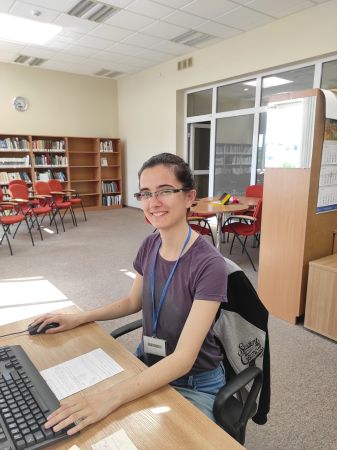
My name is Clara Muñoz, I’m from Argentina and I’m of Lithuanian descent. My great-grandparents came from Šiauliai to Argentina in 1920, and thanks to the Bring Together Lithuania program, I was finally able to visit my ancestors homeland. This program aims to give the Lithuanian diaspora around the world the opportunity to reconnect with Lithuania, get to know it, and also work in their professional field.
I’m a librarian and currently studying for a Bachelor’s Degree in Library and Information Science. When I applied to the program, I specifically requested to do my internship at the National Library of Lithuania. For me, working in such an institution was a dream come true.
During my internship, I worked in the Documentary Heritage Research Department. At the Statehood Centre, I was assigned research tasks involving Spanish-language texts on the Sąjūdis movement (the Lithuanian Reform Movement), the declaration of independence on March 11, 1990, and the events of January 1991. For the Judaica Research Centre, I conducted searches in the Argentine press on Jewish migration and its connection to cultural institutions such as YIVO, which had a presence in both Vilnius and Buenos Aires. I also collaborated with the Lithuanian Studies Unit, working with Spanish-language publications on general culture, the humanities, social sciences, and the history of Lithuania and its diaspora.
The experience at the library amazed me on many levels. The facilities are modern and accessible: reading rooms, creative spaces like makerspaces, audio rooms, free-use computers (which saved me when mine broke just after I arrived!), and a very active cultural agenda. I was able to attend, for example, a talk on democracy where the first Head of State after the 1990 independence took part. In that moment, I felt I was face to face with the history I had read so much about when I arrived.
But the thing that impacted me the most were the people. The warmth and generosity of those around me exceeded all my expectations, both personally and professionally.
I want to give special thanks to Dalia, for those small workplace chats, her kindness and warmth; to Ilona, for sharing so much with me about the country’s history, for including me in the English talks, and for answering every single one of my questions with such patience; to Dovydas, for his recommendations and advice about Lithuania; to Lara, for her warmth and cheerfulness. I’m also very grateful to my office colleagues: Anastasija, who quickly became a friend and helped me understand Lithuanian culture better (and discover how much we have in common in Argentina); and Ignė, another dear friend, who offered me different perspectives that further enriched my experience.
I learned so much about Jewish communities in Argentina and Lithuania’s history, not just the fight for independence, but also about one of its most difficult moments: the ban on the Lithuanian language. I admired how Lithuanians managed to keep their identity alive. I was also fascinated by the mythology and pagan heritage, which are still present in the deep respect for nature that can be felt so strongly here. I discovered all of this thanks to my time at the library and the daily conversations with Lithuanian colleagues and friends.
Coming to Lithuania was a turning point in my life. And being able to work at the institution I wished for the most made it even more special. I’m deeply happy and grateful.
My infinite thanks to the National Library of Lithuania team for welcoming me, supporting me, and making me feel part of this wonderful place. I’m leaving with not only knowledge, but also friendships, emotions, and a piece of Lithuania in my heart.