A Dream Come True

By Clara Muñoz


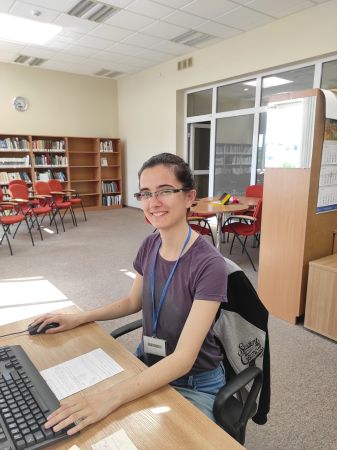
My name is Clara Muñoz, I’m from Argentina and I’m of Lithuanian descent. My great-grandparents came from Šiauliai to Argentina in 1920, and thanks to the Bring Together Lithuania program, I was finally able to visit my ancestors homeland. This program aims to give the Lithuanian diaspora around the world the opportunity to reconnect with Lithuania, get to know it, and also work in their professional field.

I’m a librarian and currently studying for a Bachelor’s Degree in Library and Information Science. When I applied to the program, I specifically requested to do my internship at the National Library of Lithuania. For me, working in such an institution was a dream come true.

During my internship, I worked in the Documentary Heritage Research Department. At the Statehood Centre, I was assigned research tasks involving Spanish-language texts on the Sąjūdis movement (the Lithuanian Reform Movement), the declaration of independence on March 11, 1990, and the events of January 1991. For the Judaica Research Centre, I conducted searches in the Argentine press on Jewish migration and its connection to cultural institutions such as YIVO, which had a presence in both Vilnius and Buenos Aires. I also collaborated with the Lithuanian Studies Unit, working with Spanish-language publications on general culture, the humanities, social sciences, and the history of Lithuania and its diaspora.

Continue reading “A Dream Come True”
A talk on how to search for Lithuanian data in US archives

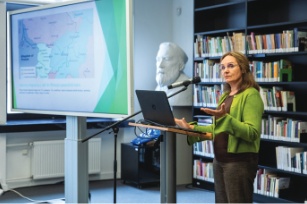
Vaitkutė gave a talk on the search of Lithuanian data in US archives. Photo: National Library of Lithuania/ Vygaudas Juozaitis

This summer, the National Library of Lithuania hosted a talk on how to search for Lithuanian data in US archives and genealogical websites presented by Karilė Vaitkutė, head of the Genealogy Department at the Balzekas Museum of Lithuanian Culture in Chicago (USA).

Vaitkutė shared her experience with how to search for Lithuanian material in various US archives, as well as paid and free-of-charge genealogical websites, how to decipher the documents found, how to determine whether they belong to a family member under consideration, and how to overcome the obstacles that occur during the research. In her talk, she also answered more specific questions concerning the search for Lithuanian relatives in the USA and gave an overview of the different sources available.

For the past ten years, Vaitkutė has been working in the field of genealogy, helping Lithuanian Americans whose grandparents and great-grandparents came to the USA before World War I or after World War II to find their roots in Lithuania and Lithuanians who are looking for their relatives in the USA.

Historical letters handedover to the National Libraryof Lithuania

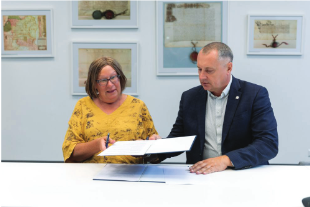
The signing of the document. Photo: National Library of Lithuania/ Vygaudas Juozaitis

This year, Lithuanian American Nijolė Bražėnaitė-Lukšienė-Paronetto turned a hundred years old. On this occasion, the National Library of Lithuania invited Nijolė’s friends and all those interested to an evening to commemorate this anniversary. The event featured a presentation of the book “Apie anuos nepamirštamus laikus: Juozo Lukšos-Daumanto ir Nijolės Bražėnaitės susirašinėjimas” (About Those Unforgettable Times: The Correspondence between Juozas Lukša- Daumantas and Nijolė Bražėnaitė) compiled by Laima Vincė.

During the event, the author of the book handed over a valuable gift to the Library—letters written by Bražėnaitė to Juozas Lukša-Daumantas, which testify not only to the romantic love story of the two young people but also to the great sacrifice they made in the name of their homeland, Lithuania.

On July 18, the formal handing over of the letters and the signing of the documents occurred. The document was signed by the donor, Laima Vincė Sruoginis, and Aidas Sinkevičius, Deputy Director General of the National Library of Lithuania.

Documentary Series “Hope on Both Sides of the Atlantic”

The Lithuanian National Broadcaster, the Lithuanian National Radio and Television, has created a series of documentaries “Viltis abipus Atlanto” (Hope on Both Sides of the Atlantic) which narrate stories of famous American-Lithuanians and Lithuanian cultural phenomena in the US. Three films are dedicated to the first wave of economic emigrants from Lithuania and its three descendants, doctor Aldona Šliūpaitė, collector and journalist Aleksandras Mykolas Račkus, and Stanley Balzekas Jr., the founder of the Balzekas Museum of Lithuanian Culture in Chicago. Other series present the second wave of political refugees, American-Lithuanian poet Kazys Bradūnas and the American-Lithuanian activist Juozas Polikaitis. The other two documentaries are dedicated to the oldest and longest-running Lithuanian newspaper Draugas and the Lithuanian neighborhood in Chicago, Marquette Park.

All series were directed by Justinas Lingys; screenwriters: Audronė Kosciuškienė and Aušra Kalinauskienė. The series can be viewed online at: https://www.lrt.lt/mediateka/video/viltis-abipus-atlanto (only in Lithuanian).

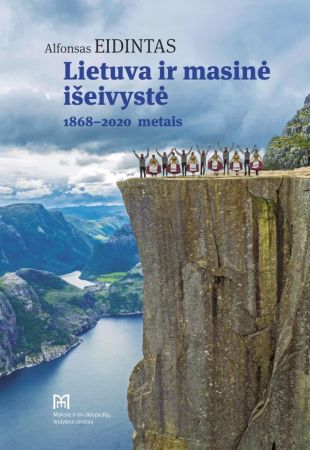
The New Book about Lithuania’s Mass Emigration

The new book discusses the mass waves of Lithuanian emigration in 1868-2020, their emergence and the public reaction to them. The author of the book, prof. Alfonsas Eidintas, raises a series of important questions: How do the emigration centers affect the current emigration; What is the impact of the emigration on the homeland; How does it affect the nation; Is emigration useful or damaging to nation’s and state’s development?

The book distinguishes two periods of Lithuanian mass emigration: from 1868 to 1915 and from 1990 to 2020. Prof. Eidintas does not doubt that both of them have been extremely significant for the life of the Lithuanian nation and the state.

The first wave of mass emigration significantly reduced the number of Lithuanians in Lithuania. Emigration to America was economically, politically and culturally the most significant in the life of the Lithuanian nation. First of all, Lithuanian colonies were established in America, which became a magnet for new emigrants. Mass exodus from Lithuania was not viewed ambiguously. Although it weakened Lithuanian nation, Lithuanians in the United States, mobilized by their own organizations, helped culturally and economically to achieve the nation’s aspirations. Prof. Eidintas notes that not only cultural and economic but also political support was received and constantly expected from Lithuanian colonies in the US.

Continue reading “The New Book about Lithuania’s Mass Emigration”

New Home of the Baltic University Archive

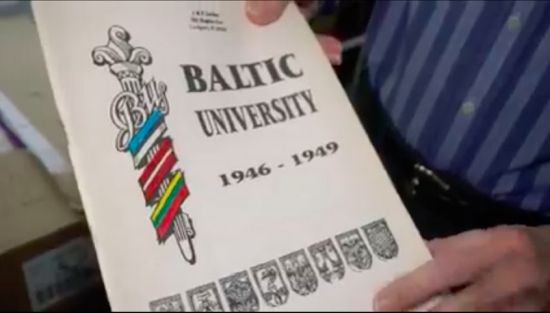
Baltic University was founded in Hamburg, Germany, on March 14, 1946. Later on, it moved to Pinneberg and functioned there until October 1949. Pranas Jurkus was a student at the Baltic University. He never forgot his first Alma Mater. Throughout his life, Jurkus was collecting material about the University professors and students and was instrumental in arranging the commemorations of the University anniversaries. In March of 2021, he donated the Baltic University archive to the Balzekas Museum of Lithuanian Culture in Chicago, USA, where it will be available to the researchers.

In the video, Pranas Jurkus tells the story of Baltic University and his life-long attachment to it: https://www.facebook.com/100057524774883/videos/2683309528648027/ (in Lithuanian)