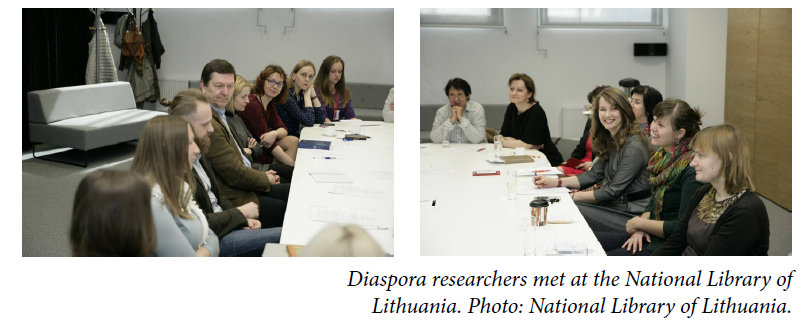
 On May 4, 2017, National Library of Lithuania held 4th interdisciplinary diaspora seminar, bringing together researchers from different academic fields. This year’s event, organized by Lithuanian Studies Department, offered a few interesting perspectives on Lithuanian diaspora.
Prof. Dr. Rūta Stanevičiūtė and Prof. Dr. Danutė Petrauskaitė introduced their project, “Nylon Curtain? Lithuanian Musical Correspondence in the Cold War Era.” Together with a colleague Dr. Vita Gruodytė they plan to research the correspondence that took place between musicians living in exile: France, Poland, and USA, and their relatives and colleagues in Lithuania.
Kristina Dūdaitė, researcher at Judaica Department of the National Library of Lithuania, talked about approach to emigration in Jewish and Lithuanian press and literature in inter-war period. She observed that although the two ethnic groups lived side by side, emigration meant to them different things.
A Ph.D. student from Vytautas Magnus University in Kaunas, Egidijus Balandis, who is working on his thesis about sports in Lithuania from the end of the 19 century to the 1990s, noted that in Lithuania, history of sport has been greeted with a lot of scepticism and is still a very underdeveloped field in universities. According to him, currently research in history of sport lacks analytical approach to the sport and its social and cultural dimensions.
Vilnius University doctoral student, Kęstutis Kilinskas, looked at diaspora archives through the eyes of a military researcher. He raised questions about Lithuanian nonprofit military organizations that started to spring in the US at the end of the 19 century and at the beginning of the 20 century, also the inter-war Lithuanian officers and soldiers’ situation and their activities in America.
Marija Bražienė, who is pursuing her MA degree at Vytautas Magnus University in Kaunas and works at the Presidential Valdas Adamkus Library-Museum, presented her findings about traumatic memory and ways of overcoming it in memoirs written by DPs. A Ph.D. student from Vilnius University, Rūta Lazauskaitė, talked about the search of archives of the famous Lithuanian philologist, literary critic and public figure, Juozas Ambrazevičius, who at the end of World War II was forced to leave Lithuania, finally settling in the US.
Professor Dr. Giedrius Subačius, Endowed Chair in Lithuanian Studies at the University of Illinois at Chicago and the AABS president, introduced participants with the Association for the Advancement of Baltic Studies. Another guest, Lituanus editor-in-chief, Prof. Dr. Almantas Samalavičius, invited everyone to publish their articles in quarterly journal dedicated to Lithuanian studies.
The meeting culminated in great presentation by Dr. Gražina Sviderskytė, who talked about the great narrative of Lituanica flight, when in 1933, two American-
Lithuanian pilots on their way to Lithuania crashed and died in Poland. The presenter discussed new methods used in her research and shared discoveries.
All earlier seminars were accompanied by book presentations or film screenings. This year
was no exception. We ended the seminar with a documentary film Remembering My Mother‘s Voice (2015) in a newly opened Movie Theater at the Library. The film is about a world-renowned opera singer American-Lithuanian Arnold Voketaitis. The documentary was presented by the director Agnė Marcinkevičiūtė.

 A new book The Art of Identity and Memory: Toward a Cultural History of the Two World Wars in Lithuania in series “Lithuanian Studies without Borders” came out in August of 2016. The book edited by Giedrė Jankevičiūtė & Rasutė Žukienė consists of wide-ranging set of articles. It is a forceful demonstration of how much the experience of EastCentral and Eastern Europe, largely neglected until now, needs to be integrated into evolving scholarship on the era of the world wars.
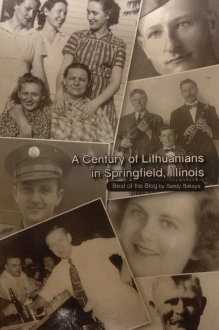 The vast majority of current Lithuanians living in Springfield, IL (USA) come from Lithuanian miners who arrived to America from Lithuania in the early 20th century. In 1914, the Lithuanian community of Springfield consisted of several thousand Lithuanians. The records of Lithuanian St. Vincent de Paul Parish in Springfield show that year, over 500 Lithuanian families belonged to the church, and between 1909 and 1919, 1,063 Lithuanian babies were baptised there. However, these figures do not indicate the actual number of Lithuanians, because quite a number of them were socialists and did not belong to the church or visited other Catholic churches in the city, such as St. Aloysius, St. Peter and Paul and St. Joseph.