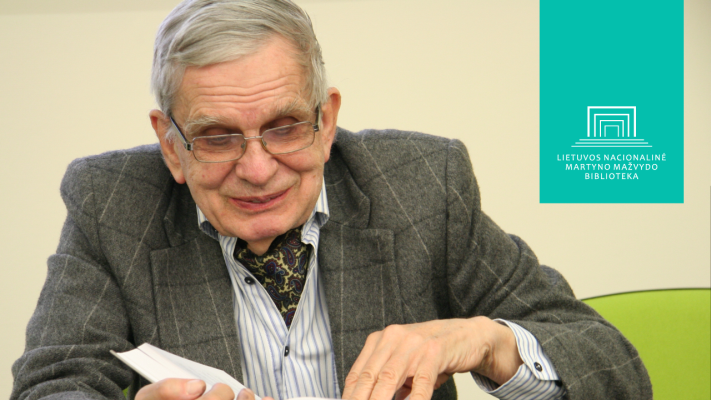
 September 11, 2017 marks the 80th birthday of Tomas Venclova, a prominent Lithuanian poet, intellectual and Professor Emeritus at Yale University, US. While living in Soviet Lithuania, Venclova became a dissident. He left the Soviet Union in 1977. In the United States, Venclova formed a triumvirate with two other émigré poets from Eastern Europe, a Russian poet Joseph Brodsky and a Polish-Lithuanian poet Czesław Miłosz. Having lived in the US for decades, Venclova is still very involved in the intellectual life of Lithuania and Europe. In his writings and by his personal example, the poet encourages the cultural and historical dialogue and challenges prevailing stereotypes. Venclova’s poetry, which blends history and personal experiences, has been translated into over 20 languages.
Venclova‘s poetry in the original language is available here >>
Quotations from translations of Venclova’s poetry
Above all, though it’s hard, love language –
humbled in newspapers, obituaries saturated with lies,
in the bedroom’s close darkness, the informer’s confession,
in the cry at the bazaar, trenches, the stench of hospital wards,
in third-rate theatres, secret police offices, on lavatory walls.
In grey buildings where the stairwell’s shaft is guarded
by steel nets, so that it is not a man, but the century,
which selects the instant of his death
<…>
It was given so that we might be different from clay,
the palm, the thrush, perhaps even from angels,
so that by naming, we should grasp objects clearly.
From poem “Commentary”; translated by Ellen Hinsey
Although I won’t be able
To shake you, still I will,
I’ll put out every taper:
The tower and the bell,
The stony streets, the shore
Bedecked with tar, and even
My soul, though I’m not sure
It counts among the living.
Here, underneath my feet,
The shaky roadway crumbles.
The shooting range, unlit,
Conceals a dark-voiced rumble
Of waves, a vast expanse,
And, from the days of Noah,
Above the depths, the dance
Of Aquilon and Notus.
From “Ode to a City,” translated by Ellen Hinsey. According to Tomas Venclova, the poem was written as a farewell to Vilnius in 1974, when he decided to emigrate.

 In 1931, Instituto per l’Europa orientale (Institute for Eastern Europe) appointed him to manage magazine Studi Baltici. In order to be able to do his job properly, Devoto tried to strengthen his knowledge of Baltic languages. In fact, in 1933, he went to Lithuania to study Lithuanian. While he was there he also taught at the University of Kaunas for about two months in French and probably Italian. Devoto travelled North twice, where he met some of the greatest Baltic scholars of that time. Because of the war, in 1942 the magazine was temporarily closed. In 1952, it started to be published again. Its last issue came out in 1969.
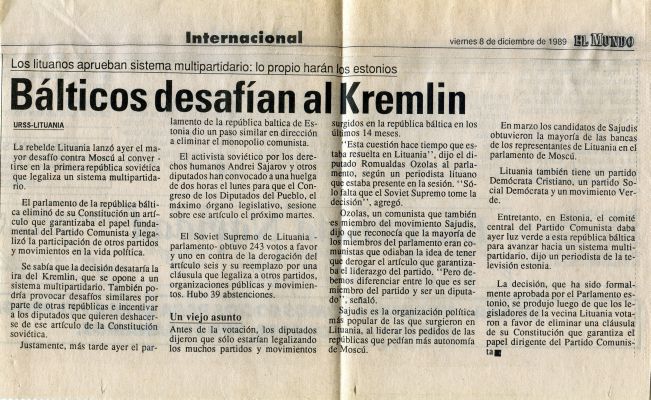 “The rebel Lithuania,” a December 1989 El mundo article begins. Although most people can point to the early 1990s as the era when the Soviet Union fell, we sometimes forget about the internal changes that once made international news. In the late 1980s and early 1990s, Lithuania made strides towards independence while newspapers across the world discussed these historic, unprecedented moves. This phenomenon makes it exciting and fascinating to read an article like this one from late 1989 Spain. The main headline reads “Baltics challenge the Kremlin,” and the article describes how the Lithuanian parliament voted in favor of abolishing an article of the Constitution that guaranteed the political monopoly of the Communist Party and thus instituting a multi-party system. As the article states, “It was well known that this decision would unleash the ire of the Kremlin, which is opposed to a multi-party system. It [the decision] could also provoke similar challenges in the other republics and incentivize the members of parliament who want to undo this article of the Soviet Constitution.”