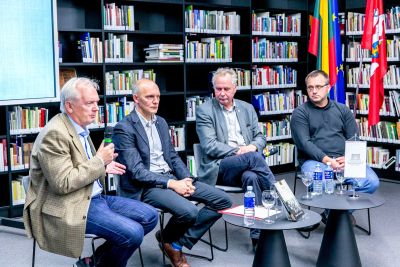
On September 26, 2018, the National Library of Lithuania hosted a book presentation. The book, War, Revolution and Nation-Making in Lithuania, 1914-1923 by Tomas Balkelis was published by Oxford University Press in 2018.
The book analyzes one of the most important periods in Lithuanian history. The author explores how the Lithuanianstate was created and shaped by the Great War and its aftermath. In doing so, he approaches the Lithuanian conflict through the lens of real people, such asrefugees, veterans, volunteers, peasant conscripts, POWs, and paramilitary fighters. The book also shows the impact the war had on the Lithuanian nation,not simply during the war, but for decades after the conflict subsided and addresses a crucial formative period in the history of the Baltic region, using Lithuania as a lens through which to view the larger East European landscape.
Dr. Tomas Balkelis defended his Ph.D. atthe University of Toronto in 2004. For several years, he worked at the Universityof Manchester, University of Nottingham, University of Dublin and Vilnius University. In 2015-2016, he was a visiting researcher at Stanford University (US). Currently, Dr. Balkelis works at the Institute of Lithuanian History. His first book, The Making of Modern Lithuania (Routledge, 2009) argued that, contrary to contemporary Lithuanian nationalist rhetoric, Lithuanian nationalism was modern and socially constructed in the period from the emergence of the Lithuanian national movement in the late nineteenth century to the birth of an independent state in 1918.
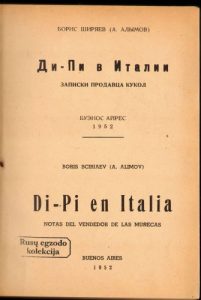 Arminio Sciolli, residing in Switzerland, decided to donate his collection of Russian exodus literature to the National Library of Lithuania. The collection consists of rare books new not only to the National Library of Lithuania but Lithuania in general. The geography of the collection covers a wide range of places – from South Africa to China – where Russian communities lived at the beginning of the 20th century. The new donation will significantly broaden the knowledge about the publishing in diaspora and open new horizons in researching the cultural history of multiethnic and multicultural Lithuania.
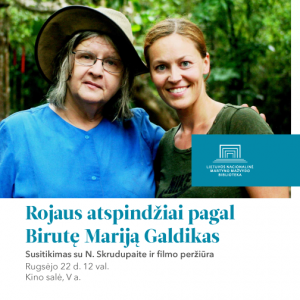 In Indonesian tropical forests, Dr. Galdikas has spent more than 40 years studying and preserving “the last great monkey living in the trees.” During these years, the orangutans have almost disappeared due to the heavy logging and hunters who sell animals to individual buyers, as well as zoos or laboratories.
 The exhibition is dedicated to the 25th anniversary of Lithuania’s independence. The title was inspired by the essay “No, my friends, we won’t go slow” written by émigré artist Jonas Mekas, published at the end of March 1990 in the New York Times, one of the largest circulation newspapers in the US.
 This year marks 70 years of one of the greatest Baltic emigration waves in the twentieth century, when at the end of the WW II, more than 280 000 Lithuanian, Latvian and Estonian citizens avoiding Soviet repressions were forced to leave their homeland. The first temporary place to live became German DP camps, where the Balts very soon revived active social, cultural and social life.