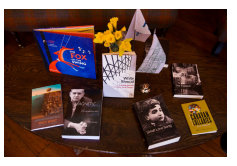
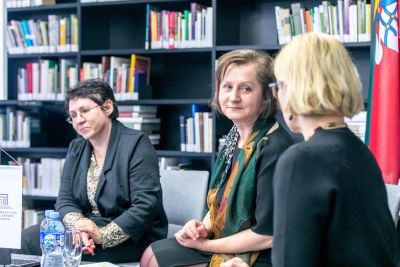
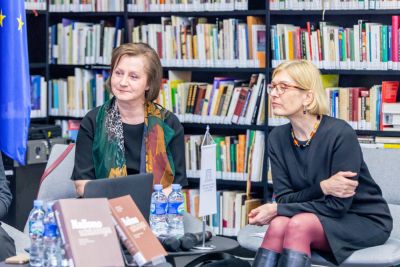
The Lithuanian World Community, Inc. together with the Lithuanian Writers’ Union and the Institute of Lithuanian Literature and Folklore is organizing the first congress of world Lithuanian writers in Vilnius. The event, which will take place on 5-7 May, 2019, will host 50 Lithuanian writers and/or writers of Lithuanian origin who currently live outside Lithuania.
During the event, the participants will meet with Lithuanian
writers. They will visit the Lithuanian Writers’ Union, the Institute of
Lithuanian Literature and Folklore and the Martynas Mažvydas National Library
of Lithuania. Readings will take place during the event. At the end of the
congress, an almanac of the participants’ fiction and poetry will be published.
For the sixth
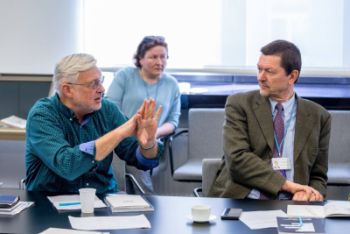
year in a row, the diaspora researchers and archivists gathered at the National
Library of Lithuania. The aim of the seminar is to bring together researchers
working in the diaspora field, especially students, to give them the
opportunity to share their research, and also to encourage the representatives
of archives and museums to introduce the Lithuanian diaspora collections housed
at their institutions to the broader audience.
The first seminar, entitled “The Young Diaspora Researchers’ Seminar,” today is known under a slightly different name, “The Interdisciplinary Diaspora Researchers’ Seminar.” Currently, the community unites about 30 researchers working in various Lithuanian universities, institutes, museums, archives, and libraries.
Photo: National Library of Lithuania
Six Perspectives on Diaspora
Six perspectives on diaspora were presented at the sixth event. Ina Ėmužienė, Ph.D., who just recently defended her thesis on Lithuanian radio and TV programs in the US from 1944 to 1990, presented the Lithuanian-American electronic media. In particular she talked about the Lithuanian radio programs that were active in the country in 1944-1990: their frequency, geography, and the circumstances of their establishment. The researcher presented a list of the Lithuanian-American radio programs that ran during that period, stressing that it is not final. She is still discovering new archives, related to the topic she has been researching.
Book presentation at the Library. Photo: National Library of Lithuania
The two-volume monograph Nylon Curtain. Lithuanian Music in the Context of International History of Cold War, by the musicologists, Prof. Rūta Stanevičiūtė, Prof. Danutė Petrauskaitė, and Prof. Vita Gruodytė, was presented at the National Library of Lithuania. The book, published in 2018 by the Lithuanian Academy of Music and Theater, consists of two volumes: a collective monograph, entitled Nylon Curtain. Cold War, International Exchanges and Lithuanian Music and a collection of correspondence, Foreign Correspondence of the Lithuanian Musicians, 1945-1990.
In the
collective monograph, the authors using extensive archival documents gathered
from the state and private archives, as well as published sources, analyze the
channels of the exchange of musical information among the individuals and
institutions in Lithuania and foreign countries that took place during the
Soviet period. They also looked into the reasons that encouraged promoting personal
and transnational relations between the two musical environments divided by the
ideological confrontation of the Cold War, and posed questions, such as: which
ideological, economic, and cultural constraints and differences limited such
exchange and what impact international exchanges had on the national music
scene.
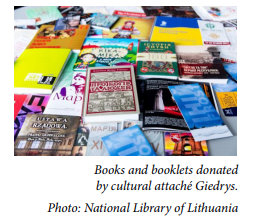
On January 22, 2019 Jurgis Giedrys, former cultural attaché of the Republic of Lithuania to Ukraine, visited the National Library of Lithuania. During the meeting with the representatives of Library, Mr. Giedrys donated numerous documents, booklets and books which he collected during his term in Ukraine, from 2015 to 2018.
More than 200 events were organized in Ukraine during Mr.
Giedrys’ fouryear term of office. People of Ukraine met with more than 700
Lithuanian artists. Events were advertised and written about by over 400
traditional or e-media outlets, as well as social media. The events dedicated
to Lithuania and Lithuanian themes attracted more than 100,000 people.
The National Library of Lithuania has been increasing its
activities in cultural diplomacy. It promotes the dissemination of Lithuanian
culture abroad, supports the efforts of foreign embassies, cultural centers and
institutes in Lithuania to present projects reflecting the world’s cultural
diversity. The Library carries out its exclusive mission by collecting the
Lithuanian documentary heritage created abroad.
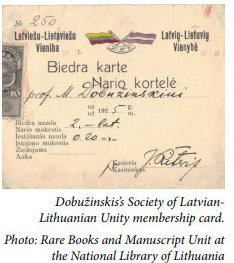
What do we know about painter Mstislavas Dobužinskis’s links with Latvia? According to philosopher Antanas Andrijauskas, before leaving for Western Europe Dobužinskis visited Riga with exhibitions [1]. What he did not mention was that the artist not only visited Riga, he lived there!
On 6 March 1924, opera “Eugene Onegin” featuring
Dobužinskis’s scenography and costumes was performed in Dresden Opera. After
the performance, the artist instead of Kaunas travels to Riga. While in Riga,
he visits K. Bauls Photo-Studio located on Alexander St. 17 and orders a stack
of photo postcards featuring his sets from the Dresden performance.
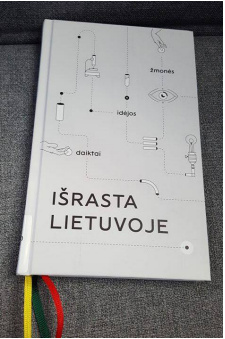
When did the first invention take place in Lithuania? Did Lithuanians have their own Thomas Edison? Why one magazine called the transatlantic flight performed by Darius and Girėnas a technical invention? Has anything changed in the world of inventions after Lithuania’s Independence in 1990s? What inventions do Lithuanians are famous for today? To commemorate the 100th anniversary of the restored Lithuania and the 90th anniversary of the Republic of Lithuania Patent Law (passed on 14 May 1928), the monograph about inventions invented by Lithuanians was published in 2018. The book written by six historians tells a story about Lithuanian inventors and inventions—from pagan times and tribal Baltic society to the present day. The book also contains a chapter written by Dr. Giedrė Milerytė-Japertienė on inventions of Lithuanian scientists who lived and worked in exile.