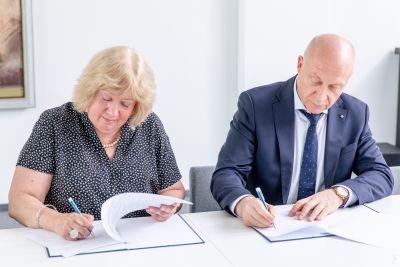
The signing ceremony. From the left: the ambassador Gintė Damušytė and the director general of the National Library of Lithuania, Prof. Renaldas Gudauskas.
On July 1, 2019 Gintė Damušytė, the Ambassador of the Republic of Lithuania to the Kingdom of Denmark and the Republic of Iceland, handed over to the Martynas Mažvydas National Library of Lithuania the archives of her mother, Jadvyga Damušienė, active émigré figure, educator, and a long-time patron of the organization “Ateitininkai “ and the Lithuanian Camp Dainava (Manchester, MI). The ambassador also handed over part of her father Prof. Adolfas Damušis’s, also the émigré activist and inventor, archive.
The Damušis’
archive consisting of more than fifty boxes and containing valuable documents and
photographs will be housed at the library’s Rare Books and Manuscripts Unit.
In May 2019, the
Gabrielė Petkevičaitė-Bitė Panevėžys County Public Library together with
Vilnius University Faculty of Communication organized the 20th international
conference dedicated to the Baltic diaspora documentary heritage from 1944 to 2018.
This year, the annual event earmarked the Year of World Lithuanians.
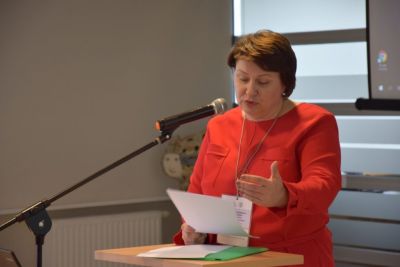
Jolanta Budriūnienė, head of the National Library of Lithuania Documentary Heritage Research Department, presented the paper in the conference
The organizers of
the conference proposed more than ten subtopics, highlighting theoretical and
methodological issues when dealing with the documentary heritage, cultural and
scientific diaspora figures and their legacy, typology of publications and
their repertoire, memory institutions and collections, archives, video and
audio, as well as preservation, actualization, and digitization initiatives,
new media, and the use of the diaspora documentary heritage for cultural
communication.
The conference was
carried out in two sections: “Archives, Collections and Obstacles in Getting
Them (Back)” and “Cultural Press and Literary-Historical Reminiscences.” 25 presentations
were presented at the event. For the first time, the conference expanded its
geographic boundaries becoming international. Participants from Estonia and
Latvia attended the conference.
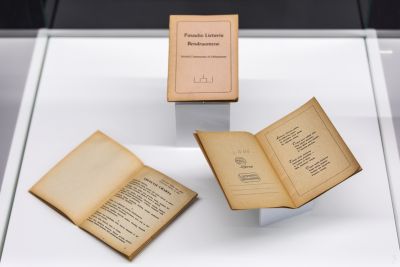
On June 14, 1949
in Augsburg, Germany, Lithuania’s Supreme Liberation Committee published a
pocket-size book World Community of
Lithuanians (Dr. Haas & Cie., KG., Augsburg), also known as the
Lithuanian Charter. The document laid the foundations of the Lithuanian World
Community, Inc., brought together and provided the new meaning to thousands of
Lithuanian war refugees.
The Lithuanian
Charter empowered Lithuanians, who after WWII once again found themselves
homeless, to continue to fight for Lithuania’s independence and to strive to
maintain at all costs not only the family and kinship, but also the national
connection, so that “each countryman met abroad [would] be like brother.”
The Lithuanian Charter is exhibited at the National Library of Lithuania.
The publication
of the Lithuanian Charter was Committee’s response to the rapidly changing
situation of Lithuanian war refugees in post-war Germany and the future full of
anxiety and uncertainty. At the end of the war, it became clear that Lithuania
would not regain its independence yet, therefore many refugees decided to take
advantage of the opportunity to immigrate to Canada, Australia, the United
States and other countries not affected by war. Prelate Mykolas Krupavičius,
the chairman of the Committee, and other members of the organization decided to
establish a Lithuanian community in each country and create one united
Lithuanian community abroad.
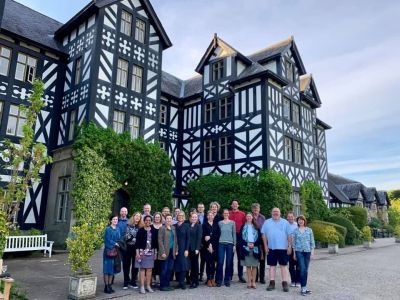
On May 14-16, 2019 the 8th Symposium of the
Entangled Media Histories research network “Current Challenges of Entangled
Media Histories—Theories, Sources and Methodologies” was organized in the Welsh
countryside outside Newtown. The symposium was hosted and organised by Jamie
Medhurst of the University of Aberystwyth in collaboration with the EMHIS
coordinator Marie Cronqvist of Lund University. The main goal of the symposium was
to discuss the future of the EMHIS network and to highlight personal challenges,
as well as cooperation possibilities.
The researchers from nine countries gathered to discuss
their problems and to present the sources and databases they use in their
research. A few presentations addressed the complicated history of the Baltic region
and research on migration.
One of them was Dr. Ina Ėmužienė, a researcher at the Martynas Mažvydas National Library of Lithuania, participant of the BaltHerNet conferences. She presented a topic on Lithuanian media in exile. In her presentation, Ina talked about diaspora research, sources, and data bases based in the Baltic region.
On May 5-7, 2019
the First World Lithuanian Writers Forum took place in Vilnius. It was attended
by more than 30 writers, translators and literary critics from fifteen
countries. The program of the forum offered a variety of activities—from literary
readings to the presentation of the anthology of world Lithuanian authors, Exodica, to a book exhibition of the
Lithuanian émigré writers organized by the National Library of Lithuania.
The organizers
of the Forum aimed at achieving several goals. The first one was to get to know
each other and share different experiences and perceptions of the world. The
event also commemorated the Lithuanian Press Restoration, Language and Book Day.
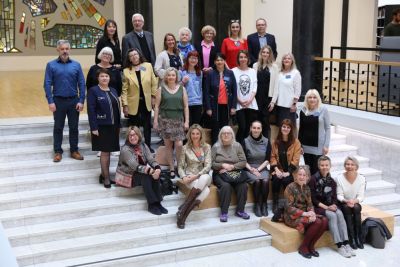
The participants of the Forum took a picture on the steps of the National Library of Lithuania.
On May 6, the
participants of the Forum visited the National Library of Lithuania. Jolanta
Budriūnienė, the director of the Documentary Heritage Research Department of
the National Library of Lithuania, presented the writers to a wide range of library’s
activities. She noted that the Library has become a place where more than thousand
various cultural events take place every year and the space for the cultural
diplomacy. “We cooperate with the embassies of the Republic of Lithuania abroad,
the Ministry of Foreign Affairs and the Ministry of Culture. We have broadened
the scope of joint works and projects in the East and West. The library is a unique
place, because it traces the signs of cultural diplomacy. It’s a place where we
systematically collect and house the books of Lithuanian authors published
abroad. Today these publications are an important part of the Lithuanian
documentary heritage,” Budriūnienė said.
The writers who gathered
at the National Library of Lithuania presented the director of the Documentary
Heritage Research Department with their books and publications published abroad
and in Lithuania. Afterwards, the participants of the Forum were given an
extensive tour of the Library.
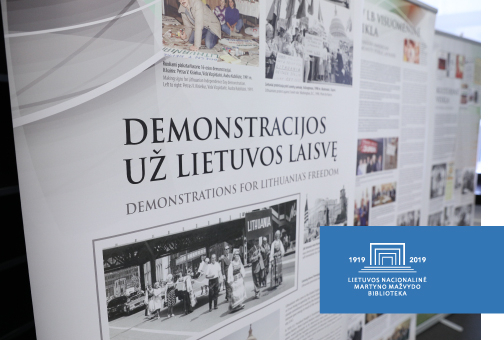
The exhibition at the Library. Photo: National Library of Lithuania
The travelling exhibition
“We Created the Lithuanian State Together: The Lithuanian-American Community,
Inc. 1951-2018” at the National Library of Lithuania highlights the fact that
Lithuanian-Americans have always kept close contact with the homeland and have
contributed to country’s development.
Lithuanian diaspora
is an integral part of Lithuanian history. Despite the geographical distance, the
Lithuanian immigrants tirelessly worked on behalf of Lithuania. Various initiatives
of many relief organizations, the financial support, active propaganda work, and
the establishment and strengthening of political, economic, and cultural
relations between the US and Lithuania are undeniable evidence of the united
struggle for Lithuanian independence.
Fighting for the
independence of Lithuania was one of the main goals of the Lithuanian-American
Community, Inc. founded in 1951. When Lithuania regained its independence, the LAC,
which unites all Lithuanians living in the US, has actively cooperated with the
homeland and its institutions, contributed to the development of ties between
Lithuanian and the US government and business representatives.
Today, the ultimate
goal of the LAC is to preserve Lithuanian culture and traditions and pass it
onto the future generations. The organization’s main emphasis is on Lithuanian
education, cultural, scientific, social, economic, religious, and sport and
other activities in the US. It cooperates with other Lithuanian-American
organizations, the US non-governmental organizations, and introduces Americans
to Lithuania. Americans of Lithuanian descent and their non-Lithuanian spouses
are also welcomed in the LAC.
The exhibition, which
runs at the Library until the end of May, testifies to the glorious history of
the LAC and introduces to its past and present activities.