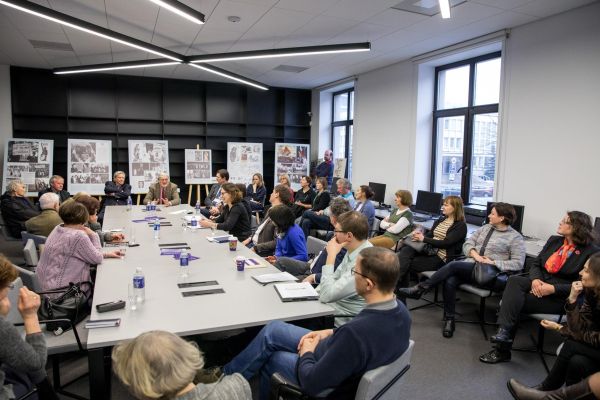
In celebration of the 100th Anniversary of Lithuania’s Independence, the Balzekas Museum of Lithuanian Culture opened a new historical exhibit “For Freedom: Lithuanian American Support for Lithuania’s Independence and Recognition.” The exhibit explores Lithuanian Americans’ passionate and energetic support for the cause of Lithuania’s independence one hundred years ago. Using photographs, documents, publications, and other historical artifacts, the exhibition gives an overview of Lithuania’s fate at the dawn of the twentieth century as a subjugated part of the Russian Empire; briefly portrays the Lithuanian American communities in America; and summarizes their significant cultural, political, and financial achievements.
The exhibition’s central focus is the vital role played by Lithuanian Americans as their native land seized a unique and complex opportunity to end its 125-year Russian subjugation. It demonstrates that Lithuanian Americans’ support for freedom in their native land did not end with the declared independence in 1918 nor with its recognition by the United States in 1922. In fact, as the exhibition shows, Lithuanian Americans supported their native land’s recurrent struggles to achieve freedom and independence for most of the twentieth century.
Drawing on materials in the Balzekas Museum as well as public and private national and regional archives and collections, the exhibition centralizes the presence of historical documents to prove that this century-long struggle for freedom was powered by ideas and ideals expressed in words and actions.
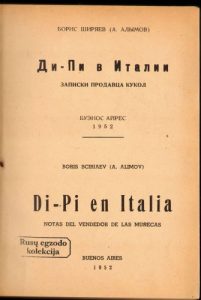 Arminio Sciolli, residing in Switzerland, decided to donate his collection of Russian exodus literature to the National Library of Lithuania. The collection consists of rare books new not only to the National Library of Lithuania but Lithuania in general. The geography of the collection covers a wide range of places – from South Africa to China – where Russian communities lived at the beginning of the 20th century. The new donation will significantly broaden the knowledge about the publishing in diaspora and open new horizons in researching the cultural history of multiethnic and multicultural Lithuania.