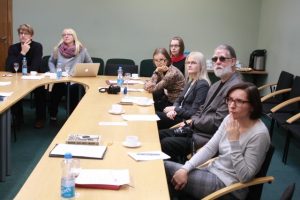
 On 3 November 2015 the Martynas Mažvydas National Library of Lithuania hosted the annual international Baltic Heritage Network diaspora seminar. It was the 22nd event in the last six years and the second to be held in Vilnius. It brought together researchers, librarians and archivists from all three Baltic countries working in the field of diaspora studies. In this international forum, eight papers were presented. Topics for three paper sessions ranged from collecting, exploring and digitizing archival data to making field research of diaspora communities, and analysing exile literature.
Diaspora seminars, covering a wide range of interests and topics, are designed to help to exchange information and encourage sustained critical dialogue without dividing attendees into their disciplinary camps. New people and presenters join the BHN seminars every year. This time the event offered a good balance between three Baltic countries and a good distribution of participants from Lithuania, Latvia and Estonia. The small-scale setting of the conference allowed for an intimate exchange of ideas. Opportunity to place one’s own research in a wider cultural context and learn about the skills and techniques used by other scholars was a significant advantage of this seminar.
The whole article can be read at >>>
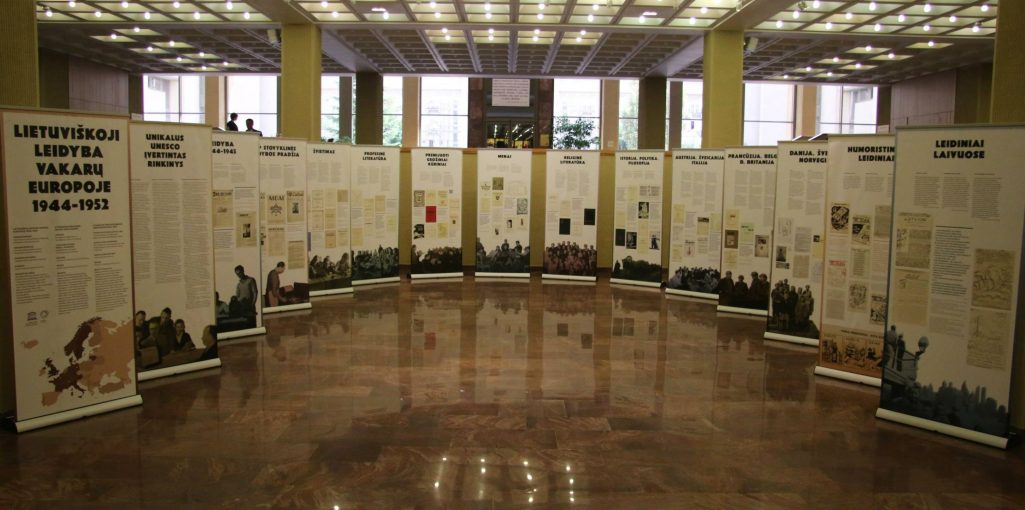
 In the opening speech, the head of the Department, Jolanta Budriūnienė, talked about the idea of the exhibition – using the rich collection of Lithuanian DP Publishing, 1945-1952, housed at the National Library of Lithuania to commemorate 70 years since the mass westward flight of the Baltic Displaced Persons, refugees from war-torn Lithuania. It should be noted that in 2011, the collection was recognised as part of Lithuania’s documentary heritage and included in the UNESCO’s program “World Memory” for the Lithuanian National Register.
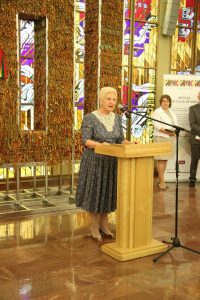 The Deputy Speaker of Lithuanian Parliament and the hostess of the exhibition, Irena Degutienė, stressed that at the end of WWII, while Europe was freeing itself, in Lithuania, guerrilla fighting had only intensified and the mass deportations were taking place. Thus, it is not surprising that Lithuanian publishing, exiled from the homeland, had to establish itself in the West. “Our language was alive and will be alive, because everything depends on our willingness to speak the language, regardless of where one lives,” Degutienė concluded her speech.
 For the second year in a row, the Lituanica Department invited diaspora researchers to the seminar. During the one-day event, the participants heard three presentations about Lithuanian diaspora. Dr Ramūnas Čičelis, the lecturer at Vytautas Magnus University (VMU), talked about the philotopic aspect in Jonas Mekas, an American Lithuanian artist; Akvilė Šimėnienė, who studies in the doctorate program at the Institute of Lithuanian Literature and Folklore, shared her findings about Dr Birutė Ciplijauskaitė’s literary criticism; and the doctorate student at the Lithuanian Academy of Arts, Jolanta Bernotaitytė, discussed the representations of the Lithuanian American art in the 20th century during the sixties and nineties. Vilnius University historian Dr Tomas Balkelis, who spoke about the international aspect of diaspora and migration studies, urged the seminar’s participants to write theirarticles and books not only to a Lithuanian, but a foreign reader as well and their research to look for Lithuanian connections with other nations and communities.
 The exhibition is dedicated to the 25th anniversary of Lithuania’s independence. The title was inspired by the essay “No, my friends, we won’t go slow” written by émigré artist Jonas Mekas, published at the end of March 1990 in the New York Times, one of the largest circulation newspapers in the US.
 This year marks 70 years of one of the greatest Baltic emigration waves in the twentieth century, when at the end of the WW II, more than 280 000 Lithuanian, Latvian and Estonian citizens avoiding Soviet repressions were forced to leave their homeland. The first temporary place to live became German DP camps, where the Balts very soon revived active social, cultural and social life.