This fall, a Ph.D. candidate Ina Ėmužienė defended her thesis on Lithuanian radio and TV programs in the US from 1944 to 1990. Electronic media is a new theme in Lithuanian diaspora history. Inher research, Ina analyzes radio and TV programs broadcasted in the US territory and mostly aimed at Lithuanian-American community. She looks at 58 radio programs and 2 TV shows describing their operating principles,organizational scale, various forms and impact on Lithuanian-American community. In doing so, Ina analyzes the US federal policy toward audio-visual media creators of national ethnic groups, explains the electronic media “strategy” developed by the Lithuanian-American community and its goals, reconstructs thespace of the audio-visual communication media within the community, its organizational principles and policies, and analyzes the role of radio broadcasts in breakthrough stages of the development of Lithuanian diaspora. While analyzing the content of Lithuanian-American radio and television programs, Ina reveals the most acute problems of Lithuanian diaspora community and attempts by radio and TV to solve them. The doctoral thesis (in Lithuanian) can be accessed at >>
The Conference Discussed the Challenges of Diaspora and Migration
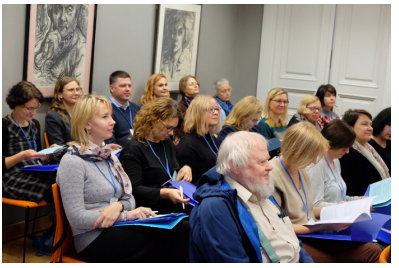
Photo: The Valdas Adamkus Presidential Library-Museum
On September 28, 2018, the Valdas Adamkus Presidential Library-Museum and the Vytautas Magnus University Lithuanian Emigration Institute invited to the second international conference “Diaspora and Migration: Theoretical Approaches, Complex and Interdisciplinary Research.” The conference was aimed at the history of Lithuanian diaspora, the challenges of modern migration, as well as other ethnic diaspora communities, history and activities of various émigré organizations, specific aspects of the diaspora culture, and comparative diaspora studies of the Baltic States.
The conference drew researchers from Lithuania, Great Britain, Poland, Latvia and Finland, who presented their research in the field of history of Polish, Lithuanian and Latvian diaspora communities,as well as the latest studies on migration processes that had taken place inrecent decades. The conference focused on theoretical insights on modern diaspora and migration research, discussed the possibilities for interdisciplinary research.
The conference was organized by the Vytautas Magnus University Lithuanian Emigration Institute, which for more than two decades has been researching the history of diaspora and migration processesand serving as an archive and library for Lithuanian diaspora heritage. The Institute has been organizing scientific conferences, seminars and exhibitions dedicated to the history of diaspora.
War, Revolution and Nation-Making in Lithuania, 1914-1923
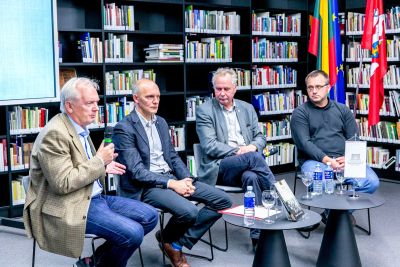
On September 26, 2018, the National Library of Lithuania hosted a book presentation. The book, War, Revolution and Nation-Making in Lithuania, 1914-1923 by Tomas Balkelis was published by Oxford University Press in 2018.
The book analyzes one of the most important periods in Lithuanian history. The author explores how the Lithuanianstate was created and shaped by the Great War and its aftermath. In doing so, he approaches the Lithuanian conflict through the lens of real people, such asrefugees, veterans, volunteers, peasant conscripts, POWs, and paramilitary fighters. The book also shows the impact the war had on the Lithuanian nation,not simply during the war, but for decades after the conflict subsided and addresses a crucial formative period in the history of the Baltic region, using Lithuania as a lens through which to view the larger East European landscape.
Dr. Tomas Balkelis defended his Ph.D. atthe University of Toronto in 2004. For several years, he worked at the Universityof Manchester, University of Nottingham, University of Dublin and Vilnius University. In 2015-2016, he was a visiting researcher at Stanford University (US). Currently, Dr. Balkelis works at the Institute of Lithuanian History. His first book, The Making of Modern Lithuania (Routledge, 2009) argued that, contrary to contemporary Lithuanian nationalist rhetoric, Lithuanian nationalism was modern and socially constructed in the period from the emergence of the Lithuanian national movement in the late nineteenth century to the birth of an independent state in 1918.
Exhibition and Discussion about Russian Diaspora Publications and Publishers
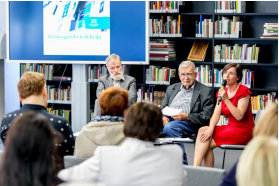
At the start of 2018, a Swiss Arminio Sciolli decided to donate part of his Russian diaspora literature collection to the National Library of Lithuania. The collection consists of rare books, not yet seen in Lithuania. The geography of the collection covers a wide range of places – from South Africa to China – where Russian diaspora communities lived at the beginning of the twentieth century.
On September 21, 2018, the Library invited to the exhibition “Russian Diaspora Literature” opening and discussion about Russian diaspora publications and publishers. Dr. Pavel Lavrinec, Vilnius University professor, provided a broader context and a general overview of the exhibition. Prof. Tomas Venclova, Yale University emeritus and professor of Slavic literature, talked about the history of Russian diaspora in Harbin, China, its cultural life and his impressions from recent trip there.
Discussion on the Preservation of Lithuanian Identity Abroad
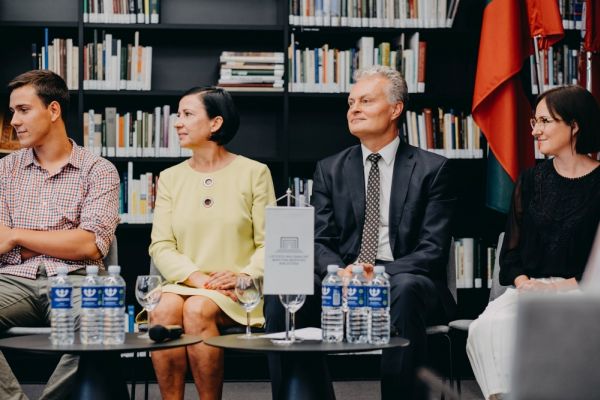
The debate about emigration, the Lithuanian identity crisis and global Lithuania is still ongoing in Lithuania. On August 14, 2018, the National Library of Lithuania hosted a discussion about how to preserve Lithuanian identity in the world organized by the Center of Lithuanian Language and Culture.
Every summer in August, the Center organizes a month-long Lithuanian language and culture course. Almost 100 students – from China to Argentina – participate in this summer’s course. Some students are of Lithuanian descent, while others, and there are many of them, want to study Lithuanian language because of their deep interest in Lithuanian culture. Vilma Leonavičienė, the director of the Center, noted that every participant has an exciting story about his relation to Lithuania to tell. For some students the summer language course is the first chance to get acquainted with Lithuania and its people, since they have only heard about this country from their grandparents or great-grandparents. However, there is a substantial group of students who have been returning to the summer language course in Vilnius.
Lemonade recipe dated from 1822*
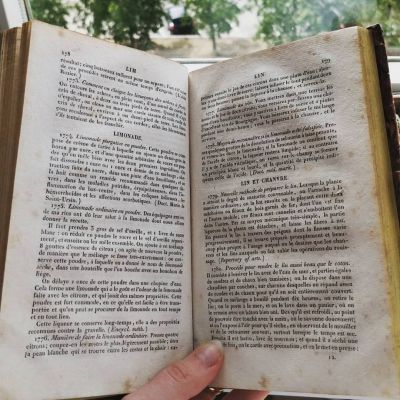
*Encyclopèdie domestique, recuile del procèdès et del recettes, Paris, 1822
- 4 lemons
- a pint of water
- half a pound of sugar
Cut off the lemon peel as much and as deeply as possible. Remove the albedo– the white flesh in between the peel and the fruit. Then, into a pint of water**, squeeze out the lemon juice, add the half pound of sugar and let rest for two to three hours.
**The water’s quantity can be increased according to taste. As well, you can alter the taste by replacing with carbonated water.
Bon Appetit!